
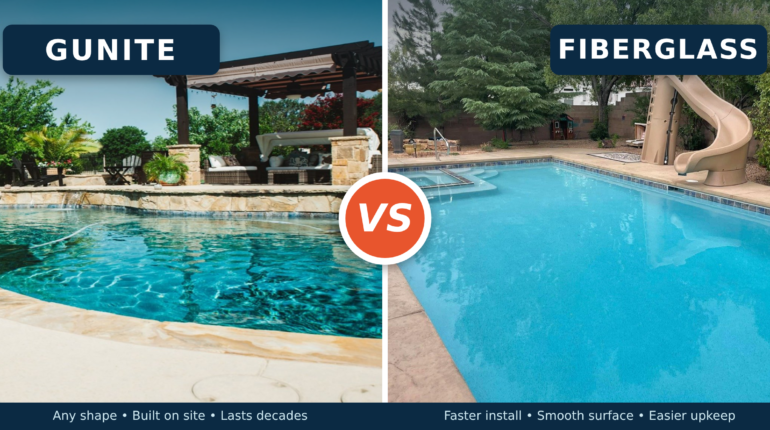
There is no single best pool. There is a best pool for your budget, your yard and how long you plan to stay in your home. Gunite gives you total design freedom and the longest lifespan. Fiberglass gives you a faster, cheaper build and an easier-to-care-for surface.
This guide compares the two on cost, lifespan, installation time, upkeep, shape options and resale value, so you can choose with real numbers. At Aqua Techs we build both in the Albuquerque area, so we have no reason to push one over the other.
Gunite vs Fiberglass Pool: The Short Version
| Gunite (concrete) | Fiberglass |
|---|---|---|
How it is built | Steel rebar frame, sprayed concrete, then a finish applied on site | One-piece shell made in a factory and set in the ground |
Typical installed cost | About $50,000 to $120,000 | About $30,000 to $85,000 |
Lifespan | 50 to 100 years for the structure | About 20 to 30 years |
Build time | Several weeks to a few months | Often days for the shell, plus time for the deck |
Shapes and sizes | Almost anything | Choose from set molds, up to about 16 ft wide |
Surface | Porous and textured, resurfaced every 10 to 15 years | Smooth, non-porous gelcoat |
Upkeep | More brushing and more chemicals | Less brushing and fewer chemicals |
Prices and lifespans vary by source and region. The ranges above combine figures from published cost guides, and your exact number depends on size, access, and finish. Guides like Angi’s gunite vs fiberglass comparison put the gap even wider, with fiberglass often costing about a third of a similar gunite pool.
How Each Pool is Built
Gunite pools are built on site. Crews dig the hole, tie a steel rebar frame, and spray concrete over it. Then they finish the interior with plaster, quartz or pebble and add tile at the waterline. Because everything is formed by hand, the pool can be any shape, depth or size your lot allows.
Fiberglass pools arrive as a single shell, built in a factory from a mold. A crane lowers it into a prepared hole, and the crew plumbs it, backfills and fills it with water. The finish is a smooth gelcoat that is part of the shell.
Cost: What You Will Really Pay
Fiberglass usually has a lower price tag. Published guides put fiberglass at roughly $30,000 to $85,000 and gunite at roughly $50,000 to $120,000, before extras. A smaller or simpler pool sits at the low end of each range, while a large, custom pool sits at the top.
Two things change the real number more than the shell itself:
- The deck, fence and equipment. These can add tens of thousands of dollars to either type. See our new pool construction page for what a full build includes.
- Long-term cost. Gunite costs more upfront and needs resurfacing every so often. Fiberglass costs less upfront and rarely needs its surface redone, but it will not last as long as the concrete shell.
When you compare quotes, make sure each one lists the same size, depth, deck, electrical work, and equipment. Otherwise, the cheapest bid may be the one that left things out.
Lifespan and Durability
Gunite structures are very long-lived. Estimates run from 50 to 100 years, and some sources say longer. The catch is the finish. Plaster typically lasts 7 to 10 years, quartz 10 to 15, and pebble 15 to 25, so you should plan on resurfacing at least once or twice. Our guide to how to remodel a pool shows what each finish costs.
Fiberglass shells typically last 20 to 30 years or more. The gelcoat is durable, and homeowners rarely need to resurface it. Over decades, the surface can fade or chalk and need a recoat, which is usually a smaller job than replastering.
Installation Time
Fiberglass wins on speed. Once the permit is approved and the shell arrives, installers can dig, set, plumb and fill the pool in a matter of days. The deck, fence and landscaping then take additional weeks.
Gunite takes longer because the concrete has to be applied, cured and finished before the pool is filled. Some builders quote a month or more, and others, particularly for large custom pools, quote several months. Weather and inspections can stretch either timeline.
If you want to swim this summer, that difference matters. If you are still designing the yard, it matters less.
Shape, Size and Design Freedom
This is where gunite pulls ahead.
- Gunite can be built in any shape. Infinity edges, built-in spas, swim-out benches, deep ends, attached waterfalls, and unusual lot shapes are all possible.
- Fiberglass comes in factory molds. Most are roughly 10 to 16 feet wide and 20 to 40 feet long, and up to about 8.5 feet deep. The 16-foot limit exists because wider loads are hard to move legally on highways.
Modern fiberglass pools come in many shapes, and with built-in tanning ledges, benches, and spa options, most families find a model they like. If your vision does not fit a mold, or your lot is unusual, gunite is the better fit. If you want a compact pool, our guide to small backyard pools covers sizes in more detail.
Surface Feel and Comfort
Fiberglass has a smooth, non-porous gelcoat that feels gentle on feet and swimsuits. Gunite has a textured finish. Plaster feels like fine sandpaper, pebble is rougher and tile is the smoothest option. Many adults like the grip of a textured finish, while families with small children often prefer smooth.
Maintenance and Chemicals
Fiberglass is easier to keep clean. Its smooth surface gives algae little to hold onto, so brushing is lighter, and algae problems are less frequent. Gelcoat also does not interact with your water chemistry the way plaster does, so you generally use fewer chemicals.
Gunite is porous. Algae can take hold in the rough surface, so it needs more regular brushing. Plaster can also raise your water’s alkalinity and requires you to keep calcium levels in range to protect the finish. Salt systems can shorten the life of plaster, so ask your builder about the finish before you choose salt.
Either pool benefits from a steady routine. Our pool maintenance guide for homeowners has a checklist that works for both.
Resale value
Results vary by market, and a well-built, well-kept pool of either type is an asset. Gunite pools are often seen as the higher-end option and tend to appeal to buyers who want a custom backyard. Fiberglass is valued for easy upkeep. Talk to a local real estate agent about what buyers in your neighborhood expect.
Which One Should You Choose?
Choose a gunite pool if:
- You want a custom shape, depth, or feature that no fiberglass mold offers
- You have a large or unusual lot
- You plan to stay for many years and want the longest-lasting structure
- Your budget is flexible
Choose a fiberglass pool if:
- You want a lower upfront cost and a faster install
- A standard shape fits your yard and your style
- You want easier cleaning and fewer chemicals
- You value predictable costs, since the shell price is fixed
Ask yourself these questions before you decide:
- How much of my budget goes to the pool, and how much to the deck, fence, and equipment?
- How long do I plan to live here?
- Is there a pool shape I want that a mold cannot offer?
- Can a delivery truck and crane reach my backyard?
- How much time do I want to spend maintaining it?
Access is a practical detail people miss. A fiberglass shell needs a clear route for the truck and crane, while gunite crews work with smaller equipment. A site visit settles it quickly.
Why the Builder Matters as Much as the Material
A well-built pool of either type will outlast a poorly built pool of the other. The excavation, the base, the plumbing, and the drainage around the pool decide how it performs for decades. Check that your builder is licensed, ask for local references, and get the scope in writing. In New Mexico, you can verify a contractor’s license through the state’s Construction Industries Division.
Because we install both gunite and fiberglass pools, our advice starts with your yard and budget rather than with a product we need to sell.
Frequently Asked Questions
Is gunite better than fiberglass?
Neither is better in every case. Gunite is better for custom designs and long-term durability. Fiberglass is better for faster installation, lower upfront cost, and easier upkeep.
Which is cheaper, gunite or fiberglass?
Fiberglass is usually cheaper to install. Gunite is often priced higher and needs periodic resurfacing, which adds to its long-term cost.
How long does a gunite pool last compared with a fiberglass pool?
A gunite structure can last 50 to 100 years, though the interior finish needs replacing every 7 to 25 years depending on the material. A fiberglass shell typically lasts 20 to 30 years or more.
Can a fiberglass pool be any size?
No. Shells are limited by factory molds and by highway transport, and most top out around 16 feet wide. Gunite can be built to nearly any size.
Do fiberglass pools crack?
Both types are durable, but either can be damaged over the years. Repair cost and difficulty are broadly similar for both, and the quality of the installation matters a great deal, so choose an experienced builder.
Which pool is easier to maintain?
Fiberglass. Its smooth surface resists algae and needs fewer chemicals than a plaster or pebble finish.
Not Sure Which Fits Your Yard?
A short site visit answers most of the questions above, including access, budget, and shape. Aqua Techs offers free estimates for both gunite and fiberglass pools across Albuquerque, Rio Rancho, Bernalillo, Corrales, Placitas, Los Lunas, and Santa Fe. Request a free pool estimate or call 505-850-3764.